May 2026 Reviews
By Alan Dove
We got another panleukopenia recovering foster kitten to care for in May, which lent itself to doing more reading. The little gremlin had to stay in our guest room (aka the “kitten room”) for most of his time here. One of the best ways to keep him company was to sit on the bed with a book in my hands. Our latest little guest, who we called Chicky, has now been adopted. However, if you live in the northern hemisphere, your local animal shelter will soon be inundated with a selection of other needy furballs as “kitten season” gets underway. Go get one, plus some good books, and settle in.
Ogawa, Yōko, translated by Stephen Snyder, Mina’s Matchbox: My friend, former mentor, and podcast cohost Vincent Racaniello recommended this one, and I see the appeal of it. Set in Japan in 1972, it’s the slice-of-life story of Tomoko, who at age 12 spends a year with her wealthy uncle’s family while her widowed mother attends school in Tokyo. When she arrives, Tomoko is stunned by the opulence of her temporary new home, and the eccentricity of her cousin Mina, a frail, asthmatic girl who rides to school on the family’s pygmy hippopotamus. As she learns more about the household, the fairytale perfection of its surface appearance gives way to her growing understanding of the family’s deep dysfunctions.
It’s a quick read, and an elegantly crafted story of coming of age, loss of innocence, and nostalgia. How much you like it will depend on your affinity for slow-paced literary fiction, and your tolerance for errors in continuity and word choice. One reason I don’t read much translated fiction is that I’m never sure how much of the original work got lost or damaged in the process. Was it Ogawa or Snyder who used “light years” incorrectly as a unit of time in one sentence, and then a few paragraphs later used it correctly as a unit of distance? Who do I blame for having one character circle a typo in a leaflet, and then stating in the next chapter that a different character circled it? Or are both of these errors inserted deliberately, to make me feel like the character who is obsessed with finding typos? I’ll never know.
Michel, L., Metallic Realms: Michael Lincoln, a broke, nerdy 30-something guy living in a Brooklyn apartment he can only afford with parental support, idolizes his childhood friend Taras Castle, a fellow slacker and unpublished sci-fi author. When Taras forms a writing group called the Orb 4, Michael dedicates himself to getting the collective’s brilliant stories published. The book is presented in alternating chapters, oscillating between the group’s fictional universe and their real one. After each of the Orb 4 short stories, we get Michael’s attempt at scholarly criticism of the work, along with notes on his own struggles and the group’s simmering interpersonal dramas. He becomes obsessed with the project, cataloging the stories while chronicling the group’s implosion and his own descent into madness.
It’s a hilarious and deeply layered satire, sending up “Golden Age” sci-fi, fandoms, Millennial angst, pretentious autofiction, urban hipsters, and a few other things. The so-bad-they’re-good short stories mirror Michael’s increasingly precarious reality, until he’s so far down his own rabbit hole there’s nothing to do but crawl into a familiar basement and hide. Anyone who reads sci-fi should check it out.
El-Mohtar, A., The River Has Roots: A dark fairytale novella, this story takes place in a small English village on the edge of the land of Faerie. It’s a liminal space where for generations, the Hawthorn family has maintained the willow trees at the border between humans and Fae. El-Mohtar mixes lyrical prose and a unique view of grammar with classic fairytale ingredients: two sisters, a villain, a witch, and a forbidden love. Fans of Susanna Clarke and T. Kingfisher will appreciate the influences and references here, but I think anyone can enjoy this short, satisfying tale. The edition I read was illustrated with pen and ink drawings by illustrator Kathleen Neeley, and the page borders were decorated with tree and meadow motifs, amplifying the storybook feeling.
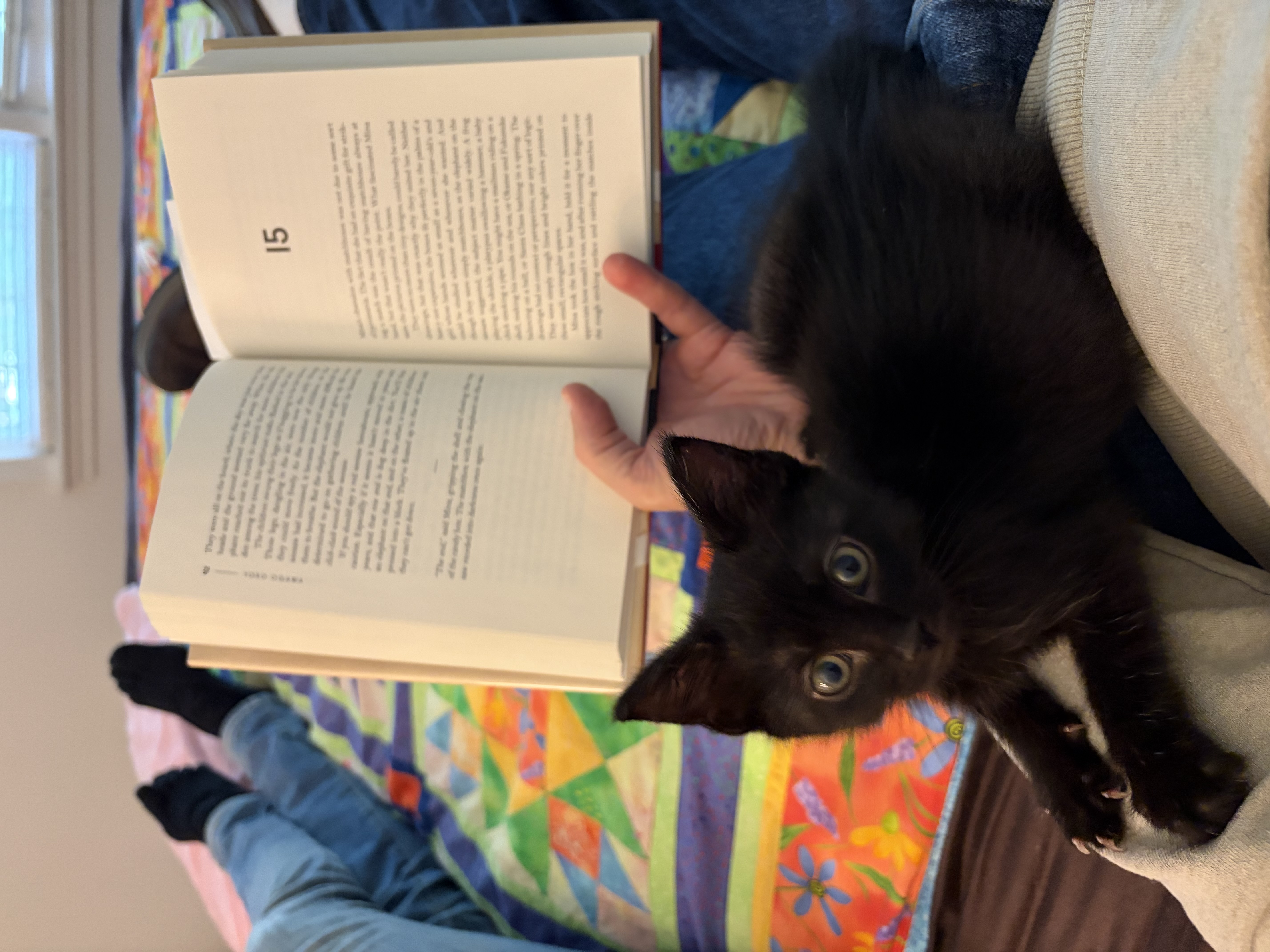 Don’t worry, his claws weren’t really as long as they look in this photo. He was just milk treading on my arm.
Kemp, L., Goliath’s Curse: Nonfiction. My gym book for much of the month, this is a deep dive into the nature of civilization and why empires always collapse. Reaching back to the roots of human evolution in egalitarian hunter-gatherer tribes, Kemp traces a long arc, from the rise of the first agricultural settlements, through early empires and colonization, all the way to our present global civilization. He makes strong, well-supported arguments against many of the common tropes of historical thinking. Civilization was not inevitable. It conflicts with many of our fundamental evolutionary traits, and has often been a disaster for 99% of the human population. Strong, empire-building leaders consistently make awful decisions, sowing the seeds of their own kingdoms’ demise.
The formation of a global network of “civilized” nations hasn’t shielded us from these problems, and has in fact amplified both the risks and likely consequences of collapse. In the final section of the book, Kemp catalogs the many ways it could come, ranging from nuclear holocaust to climate chaos, and lays out his recommendations for averting catastrophic outcomes. None of his suggestions will come as surprises: flatten obscene wealth inequity, strengthen democratic institutions, and redistribute power much more broadly. How you feel about these ideas will depend in large part on your political slant, but if you disagree, the burden is on you to find evidence as strong as Kemp has marshalled. It won’t be easy. Indeed, if I have a complaint about this book (besides its grim outlook), it’s that its thoroughness makes it a bit of a slog at times. Nonetheless, it’s an important book that anyone interested in history or public policy should read.
Crouch, B., Dark Matter: What if you’d made one choice differently? One night, a masked stranger kidnaps and drugs Jason Dessen and sends him into an alternate version of his life. His wife is single, his son was never born, and instead of being a mediocre physics professor at a small college, he’s a world-renowned scientist with billions of dollars in funding. Yes, this is a multiverse novel, a well-worn subgenre, and it’s easy to see a lot of the plot coming.
It stands out, though, with a strong emotional through-line in Jason’s love for his family, the pacing of a thriller, and several twists I’ve not seen done with this idea before. Crouch also does a good job explaining his fictional physics, and tying it to real ideas without resorting to tired clichés. His propulsive sentences sent me hurtling through the multiverse, and I finished the book in half a day. I gather it’s now been made into an Apple TV series. I don’t have that service and haven’t seen it, but the book is excellent. Another friend and TWiV cohost, Brianne Barker, recommended this one. Thanks, Brianne!
Chandrasekera, V., The Saint of Bright Doors: When Fetter is born, his mother takes away his shadow, the first step in her plan to make him into a perfect assassin. He grows up knowing that he is fated to kill his father, the Perfect and Kind, leader of a religion with millions of followers. When he leaves his village as a teenager and moves to the big city of Luriat, though, he starts to make other plans for his life. He falls in love, goes to therapy, and joins a support group for other Chosen Ones who’ve departed from their own paths. But nothing is as it seems, and the strange Bright Doors of Luriat seem to be calling to him.
It took me about a hundred pages to get into this odd magical realist novel; Chandrasekera doesn’t believe in explaining the lore, metaphysics, or technology of his story world, even a little bit. Is Fetter’s mother insane? Is he? How much of this is real, and what does “real” even mean in this universe? Once I started to piece together some sensible aspects of the book’s offbeat world, where people post to social media and text each other, but some also consort with transdimensional devils and others may live for millennia, it was a fun trip. The pace drags sometimes and the plot meanders a lot, but it came to a satisfying conclusion that felt both surprising and inevitable.
Tyson, N., Starry Messenger: Nonfiction. This was my second gym read for the month. Neil deGrasse Tyson should need no introduction to readers of this blog, and his writing and humor are as fine as ever in this volume. Unlike his efforts to explain astrophysics and other hard science topics to a broad audience, though, he focuses his attention here on sociology and public policy, areas where he knows a lot less and presumes a lot more.
As the subtitle indicates, he wants to provide “cosmic perspectives on civilization,” and I applaud that intent. Unfortunately, he falls into a couple of traps scientists often trigger when addressing “the public.” First, he clings to the discredited information deficit model of science communication, the notion that if people just understood the facts, they wouldn’t make such irrational choices. More frustrating is his apparent susceptibility to the idea that an expert scientist is equally qualified to comment on everything else. Physicists seem especially prone to this error. The result is a book that alternates between telling the informed reader things they already knew, and making naïve prescriptions for fixing the world. At one point he criticizes the activities of the legendary policy debate team at his high school, Bronx Science, for their reliance on persuasive rhetoric rather than pure facts. If he’d spent even a single semester participating on that team, maybe he wouldn’t have developed such simplistic notions of policymaking and law.