Reviews for March 2026
By Alan Dove
Jaouad, S., The Book of Alchemy: A Creative Practice for an Inspired Life: Nonfiction. Best known for her memoir Life, Interrupted, Jaouad is a multitalented writer and artist who also happens to have had some horrifying health problems. Throughout the ups and downs of her young life, she’s found solace and inspiration in keeping a journal. She’s also found many other famous folks with the same habit, and in this book she’s invited them to contribute short essays about how and why they like to write to themselves. Each essay concludes with a writing prompt for the reader to use. Divided into ten sections of ten essays each, the book is intended to be used as a “100 day challenge:” read the essay, write to the prompt in your journal, then finish your coffee.
It’s a neat idea, and many of the essays are interesting. Most of the prompts seemed fine, if you like writing to a prompt, but I don’t. To the extent I do keep a journal, erratically, I pick it up only when I feel the need to write my way through an idea I already have. Turning it into a daily habit doesn’t appeal to me. If it appeals to you, however, or if you haven’t yet figured out whether journal-keeping is something you want to do, this would be a great place to start.
Kumekawa, I., Empty Vessel: Nonfiction. I have a longstanding interest in maritime history, especially the ways it connects to every other aspect of human history, so the concept behind this book hooked me immediately. Tracking a single barge built in 1979, Kumekawa follows its many changes of ownership, name, and location through a tumultuous 40 years of global history. Because of its many name changes, he refers to it simply as “the Vessel,” and indeed this engineless floating container is defined by the empty space within it, and how various owners choose to use that space. It’s a great idea, and could have made an excellent long magazine article. Unfortunately, in expanding it into a full-length book, Kumekawa fills out the Vessel’s story with two types of lengthy digressions that I found annoying.
First, he embarks on overlong information dumps about the workings of the shipping industry. These may be somewhat useful if you’re new to the subject, but even if you don’t know about flags of convenience, Lloyd’s register, or the peculiar lawlessness of international waters, you probably don’t need to read dozens of pages about each to get the gist.
Worse, Kumekawa revels in long, repetitive diatribes about the neoliberal economics, globalization, and wealth concentration that have dominated the past few decades. Everyone from the Bernie Bro left to the MAGA right should know this stuff by now, with the chief disagreement between them being whether we should try to fix the mess or burn it all down and leave our kids to clean it up. This book adds nothing to that discussion. Overall, it was a disappointment.
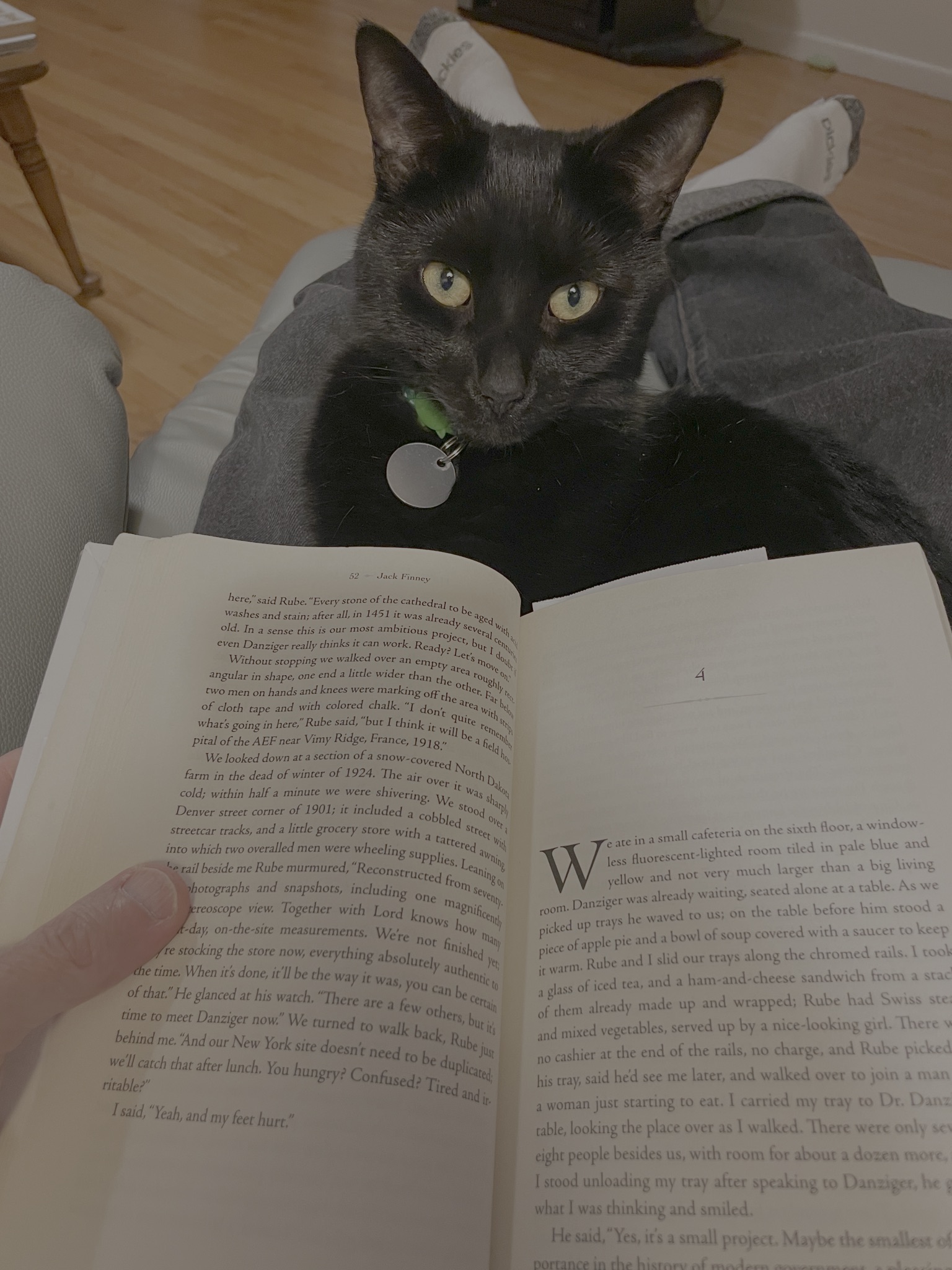 In the usual chair, with the usual book rest.
Butler, O., Parable of the Sower: As I’ve mentioned before, I’m not a huge fan of dystopian or post-apocalyptic fiction, primarily because I find much of it too realistic. I live in a hypercapitalist cyberpunk dystopia, and the world is actually on fire, so the themes of these subgenres are too on-the-nose to be enjoyable in our present historical moment. This 1993 novel, however, has been hailed as a masterpiece of speculative fiction since it came out, and it seemed like an essential read.
Believe the hype. The characters are deep and complex, the prose elegant, and the weaving of realistic details and strong emotional beats is the work of a master. Butler is also one of those rare speculative writers who absolutely nailed her forecast. Set in 2024-2027, the story follows a young woman growing up in a California devastated by climate change-driven disasters, while the fabric of American democracy collapses and the nation’s social order descends into wage slavery and chaos. While the crises in the book are quantitatively worse than our current reality, they’re qualitatively identical.
This is not an easy story to read right now. Nonetheless, I’m glad I did. Even while painting a bleak landscape of catastrophe, Butler manages to seed it with just enough hope and empathy to show a path to redemption. Everything you touch, you change. Everything you change, changes you.
Williamson, V., The Price of Democracy: Nonfiction. This is a gripping page-turner about the history of American taxes. Wait, wait, don’t run away, I’m serious. Williamson has taken what I assumed was one of the most boring topics imaginable, and made me not only care deeply about it, but also brought me to understand that it’s a fundamental organizing principle of democracy. Beginning with an overhaul of our myths about the Boston Tea Party, she proceeds to overturn much of what I learned in history classes about the causes of the American revolution, the origins of the Constitution, and other milestone events all the way to the present.
Heavily taxed countries are strongly democratic, because when a government survives only on the willingness of the people to pay for it, the people literally own it. And most Americans seem to understand that. The majority of us aren’t against taxation, or the government; Social Security and Medicare are politically invincible, and everyone appreciates well-funded roads, clean water, and functioning fire departments. Arguments against taxation, Williamson argues, have always come from a small group of rich people keen to rule over the rest of us.
Hardcore Republican apologists will disagree with her thesis, but the burden is on them to find evidence against it. That won’t be easy, because Williamson has the receipts, citing primary texts and damning influential policymakers in their own words. Every American should read this book.
Finney, J., Time and Again: I wanted to love this book. Everyone else does, putting it on lists of the best speculative novels of the 20th century, shouting its praises from the rooftops, and claiming it cures psoriasis. Okay, maybe not that last bit, but it is widely acclaimed.
I just can’t. Published in 1970, it really shows its age. I got a hundred pages into it, and was still reading lengthy passages of exposition and scene-setting, long after I’d already intuited the general shape of the entire plot. It’s so damned slow. Flipping to the final chapter, I confirmed what I suspected about the overall story, and will now return it to the library. I read novels for recreation, and this plodding, predictable nostalgia festival wasn’t a trip I was enjoying. If that makes me shallow and unsophisticated, so be it.