Reviews for June 2026
By Alan Dove
One of the joys of picking up a new book is the sense of anticipation. Even if I’ve read the jacket summary and a review or two, there’s no way to know exactly what it’ll be like until I dive in. That’s also one of the drawbacks of picking up a new book. Unlike some other life experiences, though, it’s easy to get out of a bad book.
Wiswell, J., Wearing the Lion: Having enjoyed Wiswell’s first novel, Someone You Can Build a Nest In, I figured it was worth checking out his sophomore effort. This time, he’s taken his inspiration from Greek mythology, with a gentle, humorous take on the story of Hercules (aka Heracles). One of the gods of Olympus sent a fury to possess Heracles, causing him to commit an appalling crime. In order to atone, and find out which god is responsible, he must carry out his famous labors, most of which involve slaying unkillable monsters. He dedicates these legendary deeds to his namesake, Hera, the goddess of families, and prays to her to aid him in his search for vengeance. But Heracles no longer has the stomach for violence. He befriends the Nemean lion, who he names Purrseus, cures the Lernean hydra’s migraines, and pacifies the Bull of Crete. All the while, Hera despises him, another illegitimate half-god sired by her dipshit husband, Zeus. And she keeps throwing more labors his way, hoping to stall his search for answers.
It’s a fun conceit, and the first half of the book is an entertaining ride, tracking Heracles’s growing found family and the interpersonal dramas of all-too-human Olympians. As the menagerie expands and the predictable reveals stack up, though, the story bogs down. As in Wiswell’s previous book, the psychology and sociology are a bit too trendy and on the nose. Those problems compound with the lather-rinse-repeat cycle of the twelve labors, and Wiswell’s apparent reluctance to have his characters go to really dark places. The emotional beats did land well as the slog reached its inevitable end. And I didn’t exactly dislike it; other than being too long, it was fine as a lightweight, feel-good story.
Kawamura, G., translated by Eric Selland, If Cats Disappeared from the World: My mom judged this book by its cover, calling me from the bookstore to say she’d found a really cute-looking novel and asking if I’d like for her to send it to me. Of course I said yes. Indeed, the kitten on the cover is exceptionally cute, and I say that with some authority. The book inside the cover is also cute. Too cute.
Diagnosed with a fatal brain tumor, the narrator receives a visit from the Devil, who offers him a deal: agree to make one thing disappear from the world, and he can live another day. We then get a series of short vignettes, each following one of this lonely man’s final days as phones, movies, and clocks disappear from the world. Each vignette of course centers the absence of that day’s fresh loss, and bangs us on the head with the story’s themes again: every gain entails a loss, and our connections with others are what make life worth living. It’s like a sappy, 168-page Hallmark card. I recommend settling in with a cute cat and reading a different book instead.
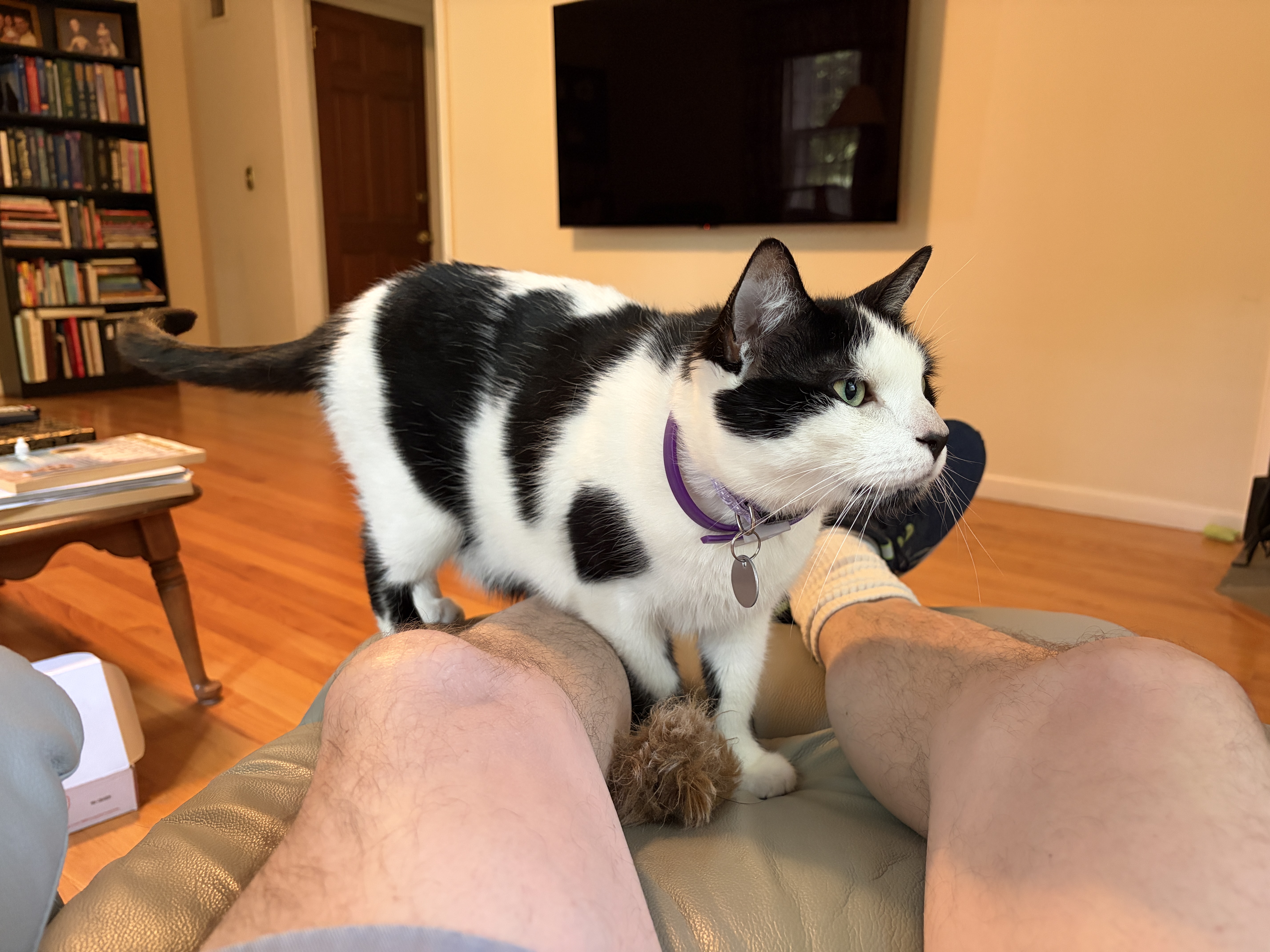 Oliver brings his favorite toy, Brown Mouse, to join me as I read.
Haskell, D.G., How Flowers Made Our World: Nonfiction. My first gym read of the month, this is a biologist’s effort to get people to stop and smell the flowers. Haskell, who’s been shortlisted for the Pulitzer Prize a couple of times, starts with a bit of evolutionary background, then proceeds through chapters dedicated to specific flowers. His central argument is that the evolution of flowering plants about 130 million years ago was one of the most transformational developments in the history of life. It’s an easy case to make. Indeed, a long essay would’ve been enough space to do it.
Having made his point by the end of the prologue, though, Haskell continues through a series of rather repetitive chapters. Some readers may bristle at Haskell’s constant anthropomorphizing, but in popular science writing I cut that a lot of slack. The bigger problem is that while the book’s subjects have succeeded through astonishing diversity, this book about them just does the same thing over and over. We learn some interesting facts about magnolias, orchids, roses, and seagrasses, and while his elegant prose goes down smoothly, I found myself wishing for something a bit less predictable. Yes, the aerobic part of my workout is almost always the same (elliptical trainer, interval program, level 8, 30 minutes), but I want my reading during that session to change things up.
Tesh, E., The Incandescent: Imagine a magical boarding school. No, not that one. I mean one that’s actually in the world we inhabit, with all that would entail. If magic was real and had been around forever, how would people think about it? What laws would govern its use? And just how much bureaucracy would be built up around teaching it?
When we meet Sapphire Walden, D. Thaum., Director of Magic at the 600-year-old Chetwood Academy, she’s filling out a risk assessment form for the A-level Invocation lab she’ll be running the next morning. Because of course there’s a risk assessment form if you want to teach a group of teenagers how to summon a demon. Not that there’s much real-world use for such a skill, and yes, she gets that question all the time.
The worldbuilding is both deep and subtle, the characters completely relatable, and the academic politics are so on point that anyone who’s ever spent time in a classroom will sympathize with Dr. Walden and her colleagues. While the initial conflict and many of the story beats are predictable, the tropes all come with delicious twists, and most of them earn full marks. Tesh, who is herself a classics teacher, gives us both the absurdist comedy and poignant emotions of modern education, while exploring themes of power and privilege. It’s an immensely fun read, and a perfect gift for any teacher.
Park, S., Luminous: In a near-future reunified Korea, a handicapped child finds an unusually lifelike robot boy in a scrapyard, a police detective on the Robot Crimes Unit investigates a strange disappearance, and a robotics engineer tries to live up to her father’s legendary accomplishments. Their stories intersect in promising ways, but glaring flaws in the prose, story beats, and plot pacing wore me out.
In several passages, attempted metaphors, similes, and descriptions collapse into incomprehensible word salad. It looks as if scraps of stoned 3am rough drafts crept into the text, and somehow slipped past the author, editor, and proofreader throughout the subsequent edits. Park also chooses to tell the story in multiple perspectives, but lacks the discipline to create and stick to distinct character voices. That leads to more confusion, especially when the leading characters interact. Finally, the pacing drags horribly, as the author seems more interested in crafting clever turns of phrase than advancing the plot. I had high hopes for this story, but abandoned it about 130 pages in.
Daniels, J.T., Make Your Own Board Game: Nonfiction. I’ve been interested in game design for years, and have even created a few video games. While there’s a vast collection of resources for video game development, however, books on making analog games are much harder to find. This is one of the few practical, general-purpose guides I’ve found, and it’s pretty good at its somewhat modest goal.
Aiming at middle schoolers (11-13 years old), Daniels has created an accessible overview of some of the most common game mechanics, concluding with classroom-ready exercises to build a few simple board games. This would be a great place for teachers to pick up ideas for a club or class. It would also make a great gift for a motivated child who’s into analog gaming. Older kids or adults looking to get into board game development can get some useful ideas from it, too, though if you’ve played a lot of games and read a little bit about the subject, you’ll probably have gleaned most of this material elsewhere.