September 2026 Reviews
By Alan Dove
Despite a major videogame distraction arriving in the middle of the month, I managed to read five books and a small collection of short stories in September. Our four furry guests no doubt helped with that, as they tend to interfere with game controls but mostly leave books alone.
Bennett, R.J., A Trade of Blood: Another month, another Robert Jackson Bennett “Shadow of the Leviathan” murder mystery. This time, the fantasy detective duo of Ana Dolabra and Dinios Kol are called to investigate what appears to be an open-and-shut case in the Khanum Empire’s agricultural heartland. A young lordling comes running out of the inn where he and his lover, an heiress of a competing aristocratic house, were enjoying a secret tryst. He’s covered in her blood, and her lifeless corpse lies back in the room, brutally butchered. Now the two families that dominate the region’s ranching industry are on the brink of a war that could plunge the entire Empire into famine and chaos. Of course, things aren’t as they seem, complications ensue, and Ana and Din once again find themselves struggling to catch up to a criminal mastermind - or perhaps more than one of them.
This series began with a pretty good concept in the first volume, reached its zenith with the worldbuilding of the second, and now seems to be settling into a decline with the third. Bennett has become so preoccupied with his editorializing that he’s lost interest in keeping the reader engaged. By a third of the way into the book, the gist of the crime is clear, and the main source of suspense is figuring out which of a few suspects was responsible. At the two-thirds mark, an alert reader may already see the shape of the ending. Meanwhile, Bennett is working his way through a tiresome diatribe against meat consumption, which he continues in his Afterword. If there are more Ana and Din mysteries on the way, I doubt I’ll pick them up; this series has jumped the leviathan.
Ashton, E., After the Fall: More than a century after human civilization collapsed and aliens arrived to settle the remains of a wrecked Earth, John, a pet human, and Martok, his alien owner, are scraping by in the aliens’ main city, Farhome. Raised from birth to be quiet, obedient, and well-behaved, John nonetheless understands that his master is an impoverished, manic outcast of the aliens’ civilization. So when Martok announces that he’s struck it rich with a new business scheme, using his pet as living collateral for a loan he can’t hope to repay, John is understandably skeptical. As the two set off for the hinterlands to build a resort for wealthy aliens, more complications pile up, and the zany scheme spirals into hilarious hijinks, leading them both to question everything they thought they knew about the world.
At least, that’s what I think Ashton was going for. Unfortunately, the story opens up a lot of heavy baggage without seeming to know what to do with it. If you’re writing about genocide, slavery, and colonialism, you need to commit to a consistent tone: serious, satirical, or perhaps black comedy. But the depths go unplumbed, the sendup doesn’t get off the ground, and the jokes don’t quite land. What’s left is a thin, trite plot with predictable beats and a happy but shallow ending. Maybe the promising premise could’ve been tightened up into a decent short story or novella, but it didn’t work in this format.
Moorcock, M., Elric of Melniboné: This classic of the fantasy genre originated in 1961, when Michael Moorcock created the central character in a series of short stories for pulp magazines. The first full novel in the saga came out about a decade later, and that’s what I’m reviewing here. We begin with Elric, the sickly albino heir to the throne of the once-great island empire of Melniboné. Though his body is weak and he depends on a steady supply of potions to get through each day, his skill at sorcery is unmatched. When he’s sufficiently drugged up, he’s also an excellent swordsman. His healthy but treacherous cousin Yrkoon covets Elric’s throne, so he can implement his plan to make Melniboné great again. Yes, that exact slogan appears in this 1972 book.
So many of the archetypes and tropes in this story have become staples of the genre that it’s hard to appreciate how original they were at the time Moorcock was writing. This was the era of Conan the Barbarian and other hypercompetent, hypermasculine heroes, so placing a flawed antihero with serious weaknesses at the center of the story was a major innovation. Elric’s saga is still a product of its time, though, with a male-dominated cast, a simplistic magic system, and a final battle so Freudian it’s unintentionally comical. Nonetheless, it was great to see where so many of modern fantasy’s roots originate.
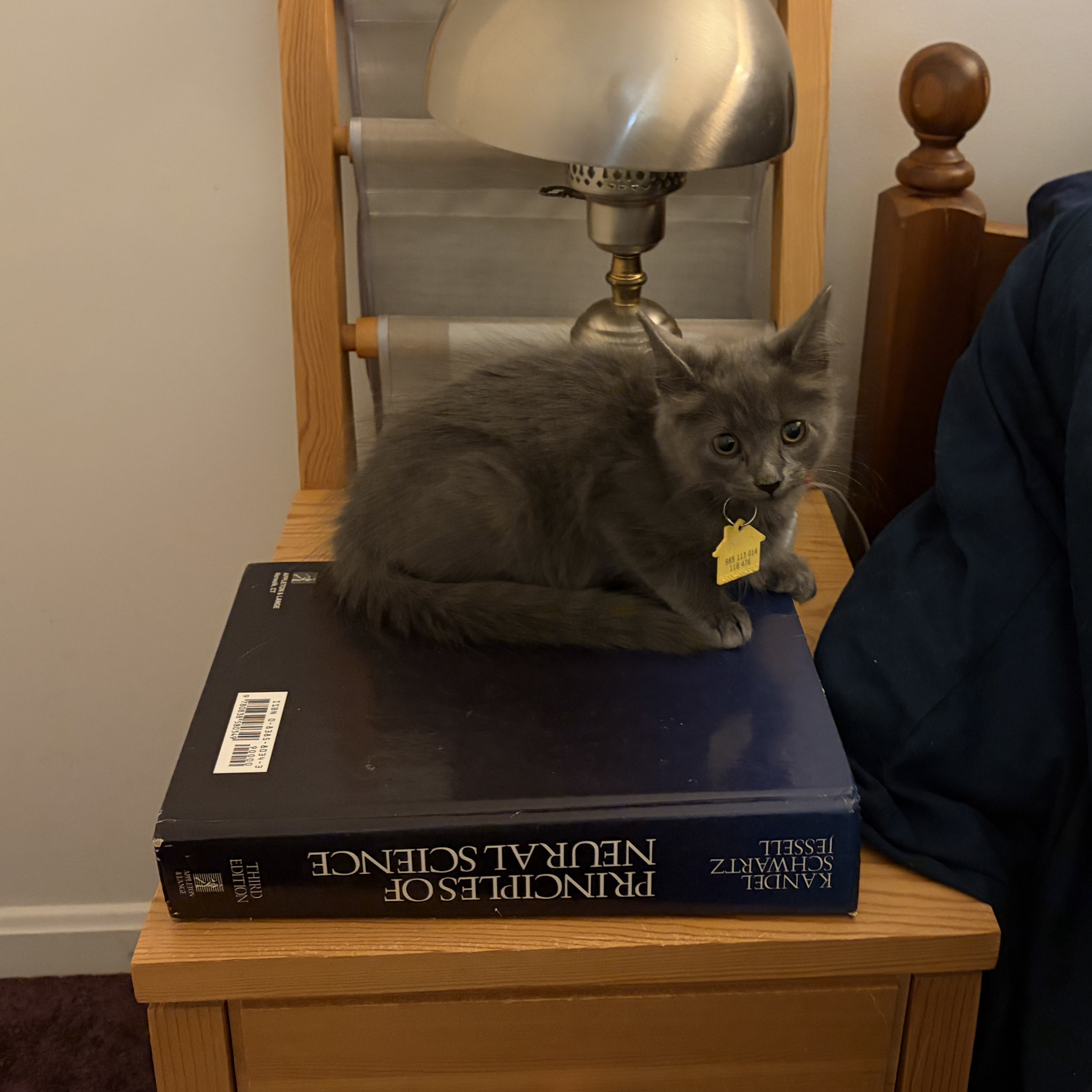 Foster kitten Churro has excellent study habits.
Lady Churchill’s Rosebud Wristlet: Do you remember zines? Way back in the late 20th century, people would type up or collate whatever was on their mind, staple it into a simple pamphlet, run off copies at their local Kinko’s (do you remember Kinko’s?), and then trade their little publications with other zine fans. The zine was a forerunner of the blog, a countercultural reaction to corporate media, and the launchpad of many artists and writers. Of course, they went extinct when everything went online, right?
Wrong. A few die-hard zines still persist, launching their genuine paper publications toward small but enthusiastic audiences at whatever frequency their aging publishers can manage. LCRW, begun in the late 1990s, is one of them, dedicated to publishing speculative fiction and offbeat nonfiction. Run by award-winning authors Kelly Link and Gavin Grant, its content is far more sophisticated than its rough-hewn format would suggest. If you enjoy innovative short stories that depart, often radically, from established genres, give it a try. There’s an e-book version as a concession to the modern realities of online commerce, but for the authenetic experience it’s best to get a paper copy mailed to you.
Winchester, S., The Breath of the Gods: Nonfiction. Having grown up around sailboats and spent a decade flying airplanes, I’ve had a lifelong interest in wind, and Simon Winchester is here to indulge it. Organized into sections focusing on winds of different velocities, from calm to tornado, this book traces humanity’s own longstanding interest in this invisible but pervasive force of nature. It’s a wide subject, and Winchester makes it even wider by including air movements of all kinds, not just the normal horizontal atmospheric currents we normally associate with the word. Everything from human breath to updrafts from wildfires gets examined here.
I found the first section the weakest, as much of it felt like the author was deliberately digressing into every bit of trivia he’s amassed in his long life. That could be interpreted as showing off his erudition, or perhaps it’s just the product of a rambling octogenarian and an editor made tolerant by his writer’s bestselling track record. Later chapters got a bit more focused, and while I knew much of the material from my own broad reading on this subject, Winchester’s elegant prose and interesting anecdotes kept things moving along.
Dolin, E.J., The Wreck of the Mentor: Nonfiction. In 1832, the New Bedford whaleship Mentor, lost in foul weather, grounded on a remote reef in the Pacific Ocean. Eleven crewmembers survived the initial wreck and reached a nearby atoll, where they were soon approached by canoes full of indigenous Micronesians, all heavily armed. They’d landed in the little-contacted archipelago now called Palau, whose language and customs were completely alien to the New Englanders. What followed was a complex and multilayered cultural conflict, as the whalers became unwitting pawns in the complex internal politics of the local tribes. Their years-long saga saw them treated alternately as honored guests, war captives, and slaves, before the few survivors finally managed to escape the islands and return home.
Drawing from primary western sources, but also making a serious effort to incorporate the oral traditions and cultural knowledge of indigenous Palauans, Dolin does an excellent job putting together the pieces of this multipart adventure. I was especially impressed at how well he wove in relevant asides, providing important context for the events that were unfolding around the main subjects. Anyone interested in maritime history should appreciate this well-researched and elegantly told tale.